

RURCODE Educational Needs Assessment Report – 18/09/2026
- International projects
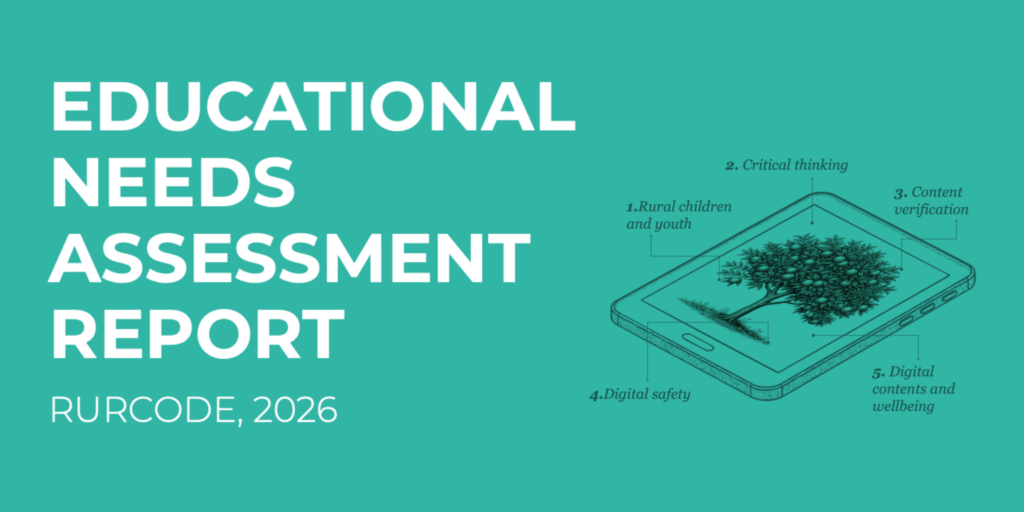
RURCODE (Rural Youth Co-Designing their Digital Education), co-funded by the European Union under the Citizens, Equality, Rights and Values (CERV) programme, is a collaborative project implemented by Fundación Maldita.es, the Federación Valenciana de Municipios y Provincias (FVMP), La Columbeta (COL), and Connect Brussels (CBR).
The project aims to strengthen digital literacy and awareness of online rights among children and adolescents aged 8-16 in rural communities in Spain and Belgium.
As part of the project, the partners carried out an Educational Needs Assessment to better understand how young people use digital technologies, the challenges and risks they encounter, and the skills and support they need. The assessment also explored teachers’ perspectives on media literacy education. Its findings are presented in the Educational Needs Assessment Report, which provides the basis for the development of the project’s educational materials.
Executive Summary
The report provides an overview of young people’s digital access, habits, competences, risks and learning needs, as well as teachers’ perspectives on media literacy education.
The findings show that digital access is not the main challenge when addressing media literacy among young people, as connectivity and devices are widely available across all contexts. The key issues concern how technology is used and the conditions of that use, particularly in terms of autonomy, supervision and purpose.
The assessment identifies a clear age-based transition in digital use, from more mediated and supervised use among children aged 8-11 to more autonomous, constant and intensive use among adolescents aged 12-16. It also highlights the central role of entertainment and social media, frequent but not always critical information-seeking practices, early exposure to digital risks, and a gap between perceived and actual digital competences.
Teachers recognise the importance of media literacy but identify a lack of training and resources as key barriers to its implementation in schools. The findings will inform the development of the project’s curriculum and educational materials.
Key Findings
The findings show that digital access is not the main challenge when addressing media literacy among young people, as connectivity and devices are widely available across all contexts. The key issue lies in how technology is used and the conditions of that use, particularly in terms of autonomy, supervision and purpose.
A clear age-based transition is observed. Children aged 8-11 use digital technologies in a more mediated and controlled way, often relying on shared devices and family supervision. In contrast, adolescents aged 12-16 display fully autonomous, constant and more intensive use, increasing both opportunities and exposure to risks. Despite this autonomy, support and supervision are uneven, which affects how young people engage with digital environments.
Internet use is fully integrated into the daily life of young people, but remains strongly oriented towards entertainment, with limited use for information or learning. Social media platforms such as YouTube, WhatsApp and TikTok are central, and usage is predominantly passive, although interaction increases with age. Influencers also play a relevant role, particularly among younger users.
A relevant finding concerns information-seeking practices, which are frequent but not always critical or structured. Younger participants tend to rely on search engines such as Google and platforms like YouTube, while adolescents increasingly turn to social media and AI-based tools such as TikTok and ChatGPT as primary sources of information. This reflects a shift towards algorithm-driven and platform-based information environments, as well as a gap between perceived and actual competences.
Another key finding concerns the early and widespread exposure to digital risks, including advertising, scams, misleading content and violent or disturbing material. This exposure is often normalised and has a significant emotional impact, especially among adolescents.
Content consumption is dominated by entertainment formats, with preferences evolving with age. Participants are aware of harmful or unwanted content, but often lack tools to manage it. At the same time, they show interest in learning, with younger children focused on creative uses of technology and adolescents on security, privacy and understanding digital systems, despite a high level of self-confidence that does not always reflect actual competences.
Gender differences are not structural but appear in content preferences, risk exposure and behaviours, while contextual differences are mainly visible in younger age groups and tend to diminish in adolescence.
From the teachers’ perspective, there is a clear gap between the recognised importance of media literacy and its implementation in schools, mainly due to lack of training and resources. Technology use is often approached through restriction rather than pedagogical integration, although teachers express a strong demand for practical support.
Facebook
Twitter
LinkedIn